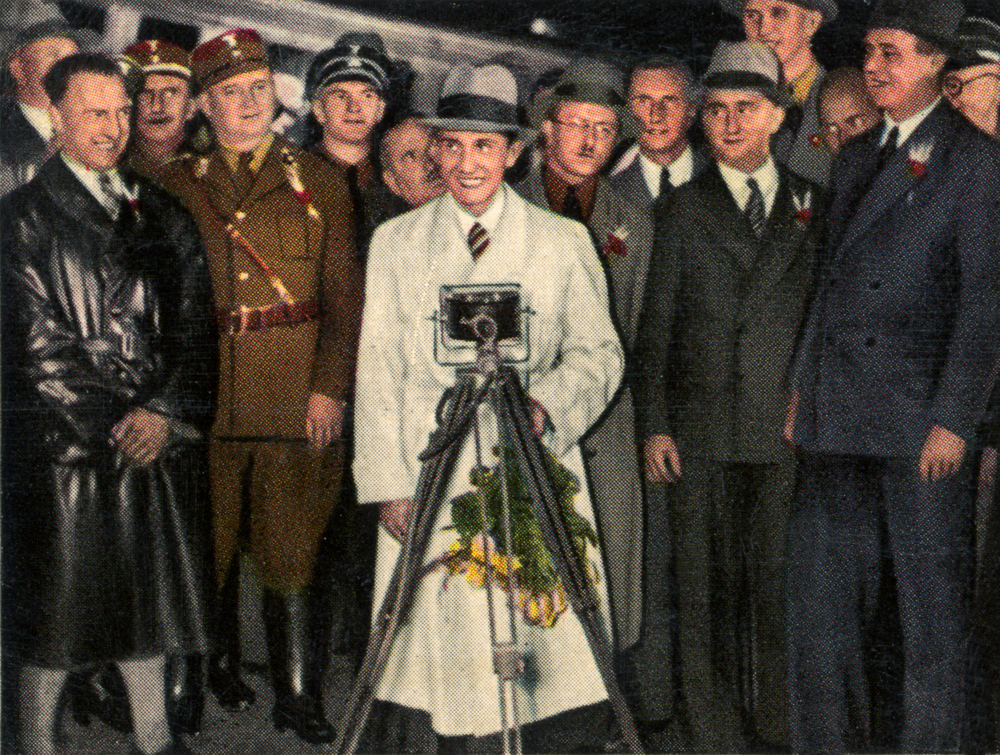
Joseph Goebbels, the infamous Minister of Propaganda in Nazi Germany, played a pivotal role in shaping and disseminating the regime’s ideological doctrines, including its eugenics policies. Eugenics, the pseudoscientific pursuit of improving the human population through selective breeding and elimination of “undesirable” traits, formed a cornerstone of Nazi racial hygiene ideology. Under Adolf Hitler’s regime, these ideas translated into horrific state-sponsored programs of forced sterilization, euthanasia, and ultimately genocide. But should we, in the 21st century, be concerned about Goebbels’ involvement in eugenics? The answer is a resounding yes. Not only does his legacy highlight the dangers of propaganda in normalizing atrocities, but it also serves as a cautionary tale amid the resurgence of eugenic-like ideas in modern discourse. This essay explores the historical context of Nazi eugenics, Goebbels’ specific contributions, the devastating impacts, and why contemporary society must remain vigilant to prevent echoes of these policies from reemerging.
Historical Context of Nazi Eugenics
Eugenics did not originate in Nazi Germany; it was a global movement with roots in the late 19th century. Coined by British scientist Francis Galton, eugenics gained traction in the United States, where it influenced immigration restrictions, forced sterilizations, and segregation laws. By the early 20th century, American eugenicists had sterilized over 60,000 individuals deemed “unfit,” often targeting minorities, the poor, and the disabled. These ideas crossed the Atlantic and profoundly shaped Nazi policies. Hitler himself admired American eugenics, citing it in Mein Kampf as a model for racial purity.
In Germany, eugenics intertwined with völkisch nationalism and antisemitism, evolving into “racial hygiene.” After the Nazis seized power in 1933, they implemented the Law for the Prevention of Hereditarily Diseased Offspring, which mandated sterilization for those with supposed genetic defects like schizophrenia, epilepsy, or alcoholism. This law affected over 400,000 people by 1945. The program escalated to the Aktion T4 euthanasia initiative, where at least 70,000 disabled individuals, including children, were murdered in gas chambers—prototypes for the Holocaust’s extermination camps. Eugenics was not fringe science; it was state policy, supported by physicians, scientists, and bureaucrats who viewed it as a progressive solution to societal ills.
Goebbels’ role was not in crafting the scientific framework but in making it palatable to the masses. As head of the Reich Ministry of Public Enlightenment and Propaganda, he controlled media, film, radio, and education to propagate eugenic ideals. Propaganda portrayed the Aryan race as superior and “degenerate” groups—Jews, Romani people, the disabled—as threats to national health.
Goebbels’ Propaganda Machine and Eugenics
Goebbels was a master manipulator, using every tool at his disposal to embed eugenics into German culture. Early Nazi propaganda focused on sterilization, framing it as a merciful act to prevent suffering. Films like Das Erbe (The Inheritance) depicted eugenics through animal analogies, showing how selective breeding improved herds, implying the same for humans. Posters warned of the “burden” of the disabled on the economy, with slogans like “Sterilization: The Right to Health.” Goebbels’ ministry produced materials that dehumanized targets, equating Jews with vermin and the mentally ill with parasites.
Ironically, Goebbels himself had a clubfoot, a congenital disability that contradicted Nazi ideals of physical perfection. He compensated by overemphasizing his intellectual prowess and ruthlessly enforcing eugenic standards on others. Through the Office of Racial Policy (RPA), led by Walter Groß under Goebbels’ oversight, eugenic education reached schools, youth groups, and households. The RPA distributed pamphlets and lectures promoting “positive eugenics” (encouraging Aryan reproduction) and “negative eugenics” (eliminating “inferiors”).
Goebbels’ efforts were crucial in radicalizing the administration. By 1939, propaganda had normalized eugenics to the point where ordinary Germans participated in or ignored the horrors. This normalization extended to the SS, where Heinrich Himmler implemented eugenic breeding programs like Lebensborn, stealing “Aryan” children from occupied territories. Goebbels amplified these through newsreels, fostering a culture of complicity.
The Devastating Impacts and Ethical Lessons
The human cost of Nazi eugenics was staggering. Beyond sterilizations and euthanasias, it paved the way for the Holocaust, where six million Jews and millions of others were exterminated in the name of racial purity. Families were torn apart, individuals stripped of dignity, and science perverted into a tool of oppression. Post-war Nuremberg Trials condemned eugenic architects, but the ideology’s roots in legitimate science made accountability complex.
Why be concerned today? Eugenics didn’t die in 1945; its shadows linger in modern debates. Advances in gene editing, like CRISPR, raise fears of “designer babies” and selective enhancement, echoing eugenic goals. Far-right movements invoke racial purity, with politicians using language reminiscent of Nazi rhetoric to justify immigration bans or welfare cuts. In the U.S., echoes appear in forced sterilizations of immigrants as recently as 2020, and in academic circles where eugenic ideas resurface under guises like “human biodiversity.”
Public health legacies persist too. The COVID-19 pandemic saw disparities in vaccine access along racial lines, fueling accusations of modern eugenics. Migration policies worldwide often embed eugenic thinking, prioritizing “skilled” immigrants while demonizing others. Genomics communities actively debunk these myths, but social media—Goebbels‘ modern equivalent—spreads misinformation rapidly.
Concern is warranted because history shows how propaganda normalizes the unthinkable. Goebbels’ techniques—repetition, emotional appeals, scapegoating—are alive in today’s fake news and populist rhetoric. Racial resentment drives support for eugenic policies more than economic fears, as studies show. Without vigilance, subtle forms of eugenics could infiltrate bioethics, AI-driven hiring, or reproductive technologies.
Goebbels’ eugenics policy, through propaganda, turned pseudoscience into mass murder, claiming millions of lives and scarring humanity. We should be deeply concerned, not out of paranoia, but to honor the victims and safeguard the future. Education, ethical oversight in science, and combating hate speech are essential defenses. As gene technologies advance and political extremism rises, remembering Goebbels reminds us: indifference breeds atrocity. By confronting this dark history, we ensure eugenics remains a relic, not a revival.